Agentic AI: The Complete Guide to Architectures, Frameworks, and Future Directions (2025)

TL;DR Summary
Agentic AI represents a transformative paradigm shift from passive AI tools to autonomous systems capable of goal-directed behavior, contextual reasoning, and multi-agent coordination. Unlike traditional AI that responds to prompts, agentic systems can independently plan, execute, and adapt to achieve objectives. The global market is projected to grow from $7.06 billion in 2025 to $93.20 billion by 2032 at a 44.6% CAGR. Modern implementations leverage two distinct architectural paradigms—symbolic/classical (algorithmic planning) and neural/generative (LLM orchestration)—with leading frameworks including LangGraph, AutoGen, and CrewAI enabling enterprise deployment. The future lies in hybrid neuro-symbolic architectures that combine symbolic reliability with neural adaptability.
What is Agentic AI? Understanding the Paradigm Shift
Agentic AI represents a fundamental transformation in artificial intelligence—moving from passive, task-specific tools toward autonomous systems that exhibit genuine agency. According to a comprehensive survey published in Artificial Intelligence Review, these modern systems are defined by capabilities including proactive planning, contextual memory, sophisticated tool use, and the ability to adapt behavior based on environmental feedback.
The distinction between an AI agent and Agentic AI is crucial for understanding this evolution. An AI agent is a self-contained autonomous system designed to accomplish a specific goal, operating primarily in isolation though interacting with tools and APIs. Agentic AI, conversely, represents the broader architectural approach concerned with creating systems that exhibit agency—often involving the orchestration of multi-agent systems (MAS) where multiple specialized agents collaborate to solve complex problems.
Consider this practical example: A single AI agent tasked with "Write a full project proposal" would autonomously break down the task, conduct research, write sections, and format the final document. An Agentic AI system designed for the same task would deploy a team of specialized agents—a project manager agent to decompose goals, a researcher agent for market data, a writer agent for drafting, and a quality assurance agent for review.
AWS defines agentic AI as AI systems that can make decisions and take actions autonomously to achieve predetermined goals, operating with minimal human supervision unlike traditional AI that only responds to direct instructions.
Agentic AI vs Traditional AI: Key Differences
The fundamental differences between agentic and traditional AI center on autonomy, adaptability, and strategic alignment. According to GeeksforGeeks:
| Feature | Traditional AI | Agentic AI |
|---|---|---|
| Core Function | Performs specific, preprogrammed tasks | Autonomously sets goals and executes multi-step workflows |
| Autonomy | Executes programmed instructions only | Sets goals, makes decisions independently |
| Adaptability | Limited to predefined conditions | Continuously adapts to changing contexts in real-time |
| Decision Scope | Single, sequential outputs | Multi-step, cross-domain reasoning |
| Collaboration | Operates in silos | Coordinates with humans, other agents, and systems |
| Strategic Alignment | Optimizes narrow tasks | Balances enterprise-wide objectives |
Traditional AI systems work within specific algorithms and fixed rules—handling well-defined tasks like data sorting, image recognition, or language translation based on predetermined constraints. Agentic AI demonstrates broader capabilities by taking an active role in problem-solving and decision-making.
The key operational difference: Generative AI creates content, but agentic AI takes action. A generative system can draft a marketing email; an agentic system can draft the email, decide when to send it, track engagement, and adjust strategy over time without further input.
The Dual-Paradigm Framework: Symbolic vs Neural Architectures
The 2026 survey published in Artificial Intelligence Review introduces a novel dual-paradigm framework that categorizes agentic systems into two distinct lineages based on systematic analysis of 90 studies:
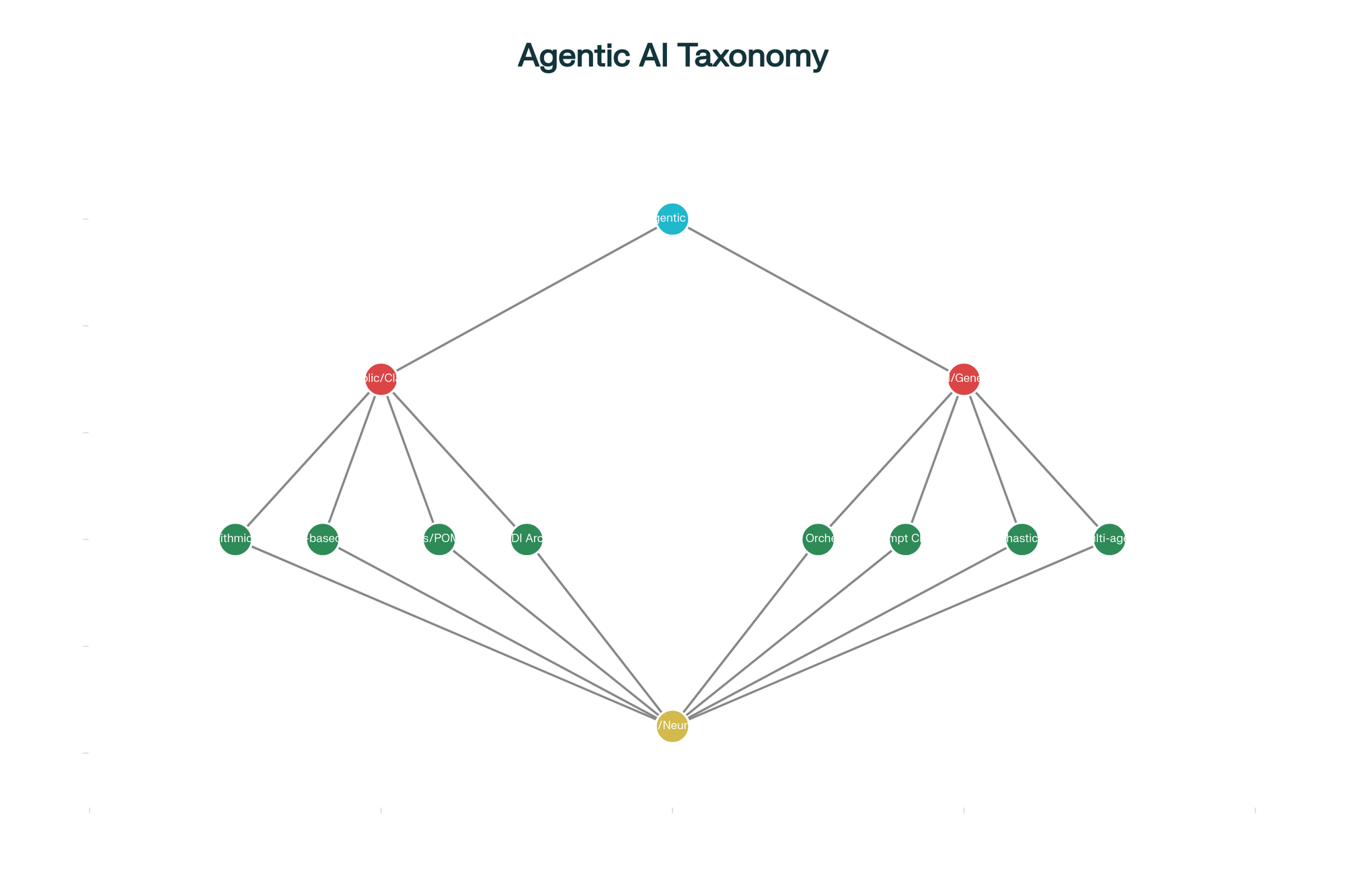
The Symbolic/Classical Paradigm
The symbolic lineage is characterized by explicit logic, algorithmic planning, and deterministic or probabilistic models. Key components include:
Markov Decision Processes (MDPs) provide mathematical scaffolding for modeling environments with full state information. An MDP is defined by states, actions, transition probabilities, and rewards—operating effectively in deterministic, rule-based domains.
Partially Observable MDPs (POMDPs) extend this by introducing probabilistic belief states to handle environments with incomplete information, representing a key advancement in allowing symbolic agents to infer hidden states through observation.
Cognitive Architectures like BDI and SOAR represent the pinnacle of the symbolic paradigm's attempt to engineer agency. These systems explicitly model internal states through Belief-Desire-Intention frameworks, directly implementing perceive-plan-act-reflect loops using symbolic representations.
The Neural/Generative Paradigm
The emergence of Large Language Models (LLMs) created a revolutionary new paradigm built on statistical learning from data. Modern neural frameworks achieve agency through fundamentally different mechanisms:
| Framework | Primary Mechanism | Functional Paradigm |
|---|---|---|
| LangChain | Prompt chaining | Orchestrates linear sequences of LLM calls and API tools |
| AutoGen | Multi-agent conversation | Facilitates structured dialogues between collaborative agents |
| CrewAI | Role-based workflow | Assigns roles and goals to agent teams |
| Semantic Kernel | Plugin/function composition | Connects LLMs to pre-written code functions |
| LlamaIndex | Retrieval-augmented generation | Retrieves and injects relevant information into context |
These frameworks do not implement symbolic PPAR loops or BDI architectures—they represent a new paradigm of LLM orchestration where agency emerges from prompt-driven orchestration rather than internal symbolic logic.
Leading Agentic AI Frameworks Compared (2025)
The landscape of agentic AI frameworks has matured significantly, with several platforms emerging as enterprise-ready solutions. According to DataCamp's comprehensive comparison:
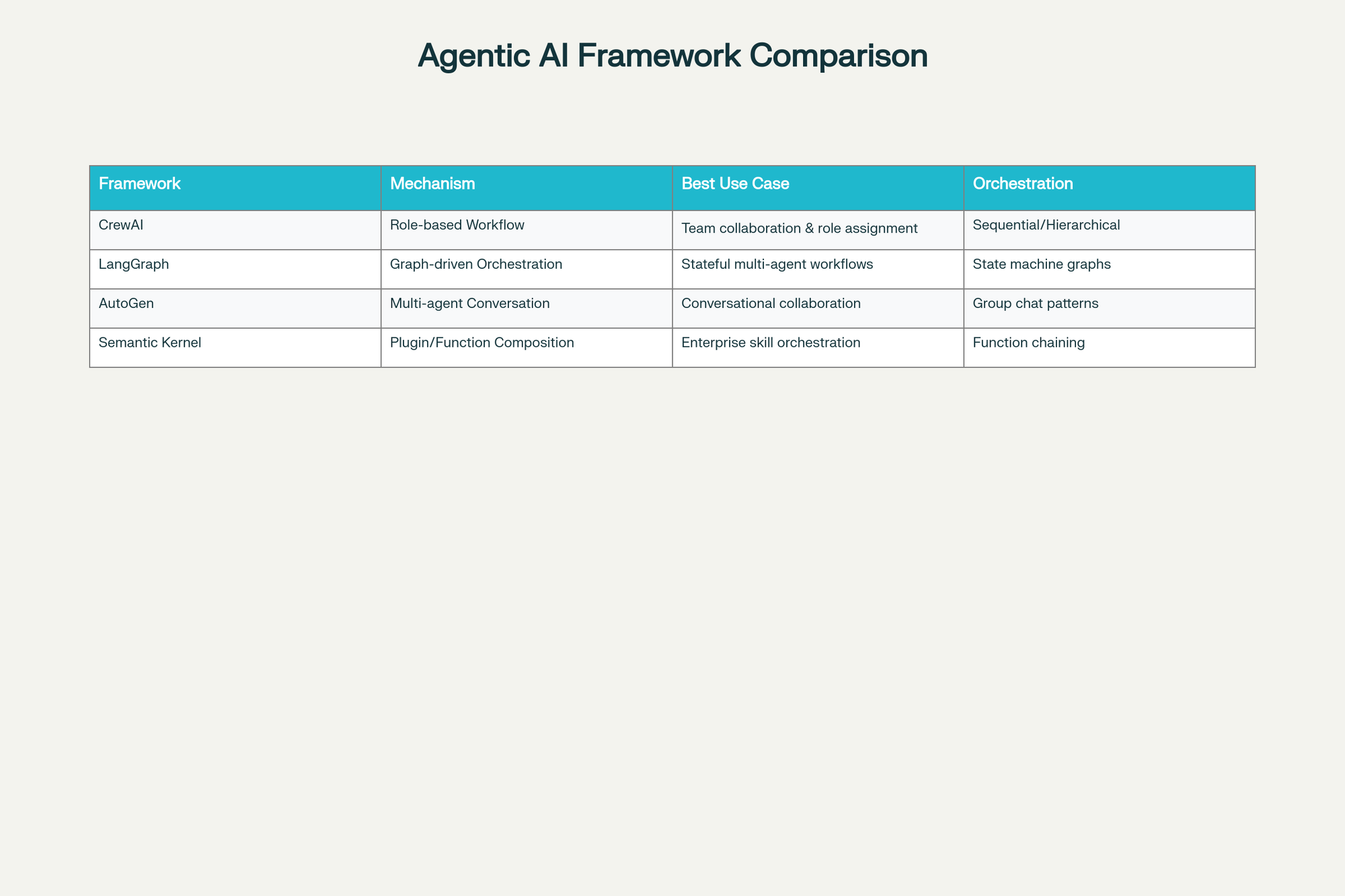
Figure 2: Comparison of leading Agentic AI frameworks by primary mechanism and use case
LangGraph
Built by LangChain, LangGraph provides a framework for creating stateful, multi-agent applications using LLMs. It models complex AI agent workflows as directed cyclic graphs, enabling loops, branching, and parallel paths.
Best for: Teams wanting balance between control and rapid iteration, SaaS startups, or product teams building agentic features.
Key capabilities:
- State machine-based workflow design
- Human-in-the-loop interventions
- Native LangChain ecosystem integration
- Strong observability through LangSmith
Learn more in the official LangGraph documentation.
Microsoft AutoGen
AutoGen focuses on multi-agent collaboration, enabling agents to engage in dialogue with each other and with humans to solve problems collectively. Its group chat model allows agents to converse dynamically and with humans in natural language.
Best for: Conversational, human-in-the-loop systems requiring flexible collaboration.
Key capabilities:
- Multi-agent conversation patterns
- Self-reflection loops
- Real-time scalable systems
- Tool integrations
CrewAI
CrewAI emphasizes role-based collaboration where each agent has clearly defined responsibilities, making coordination feel like a structured team environment. It assigns roles, goals, and backstories to agents for complex multi-step tasks.
Best for: Designing role-based agent teams visually; market analysis and collaborative intelligence.
Key capabilities:
- Role assignment and goal setting
- Sequential and hierarchical workflows
- Tool caching
- Business workflow automation
The DeepLearning.AI course on CrewAI provides hands-on training for building multi-agent systems.
Semantic Kernel
Microsoft's Semantic Kernel connects LLMs to pre-written code functions ("skills") for execution, focusing on enterprise integrations and multi-language support.
Best for: Enterprise settings, .NET ecosystems, or organizations needing robust skill orchestration.
Market Size and Growth Projections
The agentic AI market demonstrates explosive growth trajectories that signal fundamental enterprise transformation:
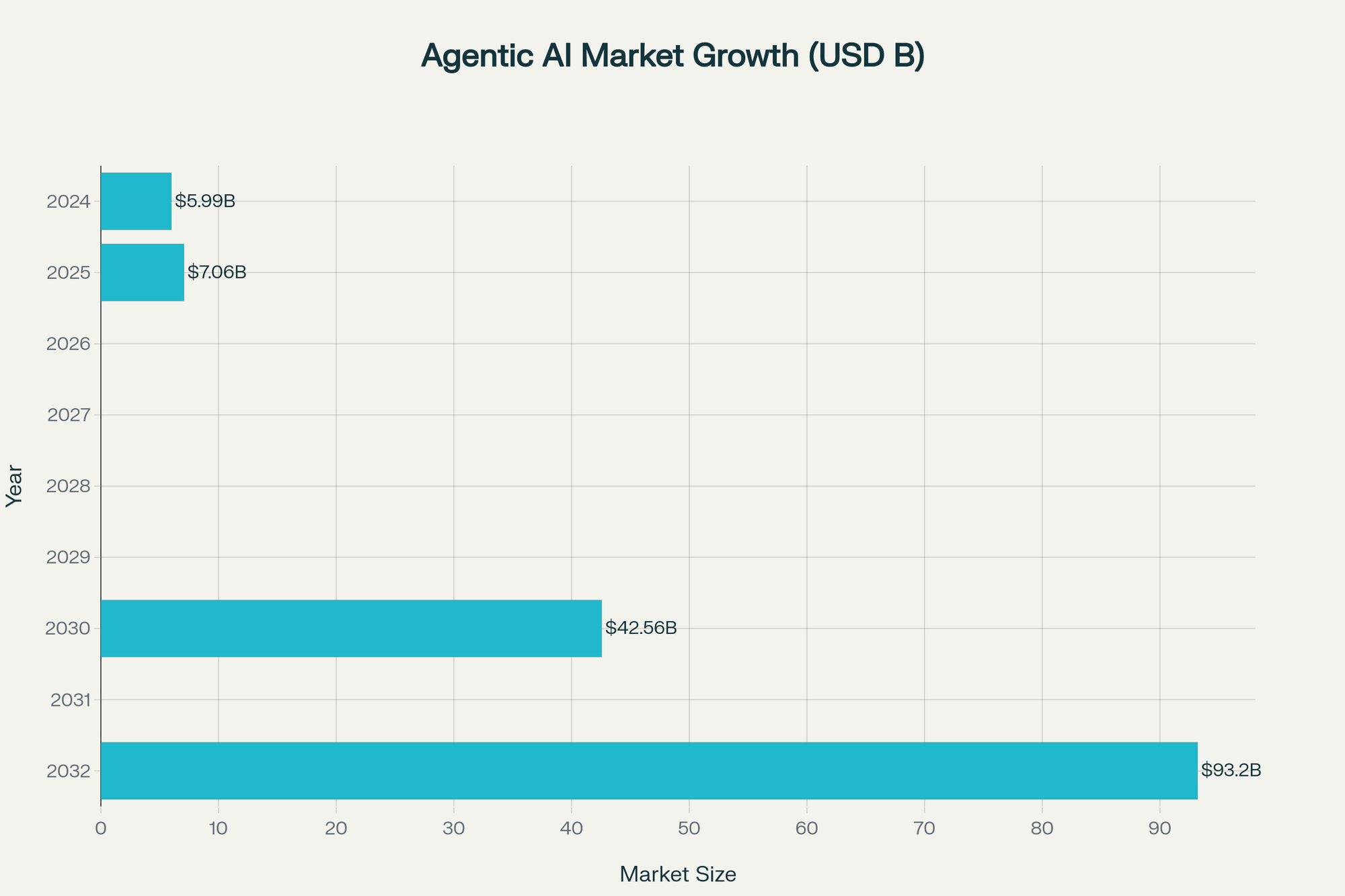
Key market statistics:
- 2025 market size: $7.06 billion
- 2032 projection: $93.20 billion at 44.6% CAGR
- Alternative 2032 forecast: $88.35 billion at 42.80% CAGR
- 2029 AI spending forecast: $1.3 trillion (31.9% YoY growth)
Regional distribution (2025):
- North America holds the largest market share with the U.S. alone reaching $1.89 billion
- Europe projected at significant growth, with Germany ($0.51B), U.K. ($0.43B), and France ($0.42B)
- Asia Pacific ranks third at $1.86 billion, led by China ($0.52B) and India ($0.45B)
Adoption metrics according to industry reports:
- 79% of organizations report some level of agentic AI adoption as of 2025
- 96% plan to expand their agentic AI usage in 2025
- 25% of generative AI users are running agentic AI pilots in 2025, expected to reach 50% by 2027
By 2030, IDC forecasts that 45% of organizations will orchestrate AI agents at scale, embedding them across business functions.
Enterprise Applications and Use Cases
Agentic AI is transforming operations across industries with domain-specific implementations. ThirdEyeData's comprehensive analysis identifies 25 major use cases:
Healthcare
The healthcare domain shows a strong preference for symbolic or highly constrained neural architectures due to safety requirements. Applications include:
- Clinical decision support using deterministic and constrained neural systems
- Personalized treatment planning analyzing patient data, medical literature, and outcomes
- On-premise edge agents for medical assistance
- Diagnostic systems achieving accuracy matching or exceeding human specialists
Healthcare AI is projected to grow at 48.40% CAGR during 2025-2032.
Financial Services
Finance leverages neural orchestration for complex analysis while maintaining symbolic systems for regulatory compliance:
- Algorithmic trading now accounts for 75% of all equity trades
- Fraud detection with real-time transaction monitoring
- ESG compliance and cryptocurrency arbitrage
- JPMorgan's COIN processes over 50,000 commercial agreements annually
CrewAI's role-based workflow enables market analysis with clear, auditable trails.
Customer Service
AI-driven systems are achieving remarkable results according to BCG's enterprise analysis:
- 60% reduction in manual workloads through ServiceNow's AI agents
- 25% increase in lead conversion with agentic campaign routing
- Automated case resolution handling complex multi-system queries
Supply Chain and Operations
Enterprise implementations demonstrate:
- Walmart's supply chain AI processing 500 million data points daily
- 94% accuracy in demand prediction
- $4.2 billion annual waste reduction
Architecture Design Principles
Successful agentic AI implementations follow structured architectural patterns according to Kanerika's architecture guide:
Core Architectural Layers
- Experience Layer: User interfaces and interaction points
- Reasoning & Planning: Decision-making and goal decomposition
- Knowledge & Memory: Short-term, long-term, and persistent memory systems
- Action Layer: Tool integration and execution
- Governance & Monitoring: Compliance, audit trails, and oversight
Memory Architecture
Modern agentic systems require sophisticated memory management:
- Short-term memory: Maintains context during immediate interactions
- Long-term memory: Enables learning from past experiences and building knowledge bases
- Persistent memory: Ensures critical information survives system restarts
Multi-Agent Orchestration Patterns
Three primary patterns define successful multi-agent coordination according to Akka's enterprise guide:
| Pattern | Description | Best For |
|---|---|---|
| Vertical | One agent leads and delegates to others | Hierarchical task decomposition |
| Horizontal | Multiple agents collaborate as equals | Peer-to-peer problem solving |
| Hybrid | Combinations of vertical and horizontal | Complex enterprise workflows |
Challenges and Limitations
Despite rapid advancement, agentic AI faces significant challenges that organizations must address. Sendbird's analysis identifies 10 major challenges:
Technical Limitations
Planning and reasoning constraints: Current systems struggle with balancing multiple variables and optimizing complex plans in dynamic environments. Many lack fundamental common sense understanding, leading to decisions that are technically correct but practically inappropriate.
Memory challenges: Managing vast amounts of data required for informed decision-making creates significant memory and computational constraints.
Multi-tool coordination: Interoperability problems, authentication complexities, and latency issues affect real-time coordination across enterprise systems.
Reliability and Predictability
According to industry analysis, 40% of agentic AI projects are projected to be scrapped by 2027 for failing to link back to measurable business value.
Task complexity often exceeds capability: Many "agentic" AI companies are overhyped ("agent washing") and cannot reliably deliver enterprise-grade outcomes.
Security Vulnerabilities
The security landscape presents critical concerns:
- 82% of companies using AI agents have them access sensitive data
- 58% experience daily interactions with sensitive information
- Security incidents include unauthorized access (39%), restricted information leakage (33%), and phishing movements (16%)
- Despite 92% agreeing governance is essential, less than half have formal policies
Cost Considerations
18.4% of enterprises cite costs as a major obstacle to scaling agentic AI. Compute resources grow quickly with agent use, creating potentially unsustainable operating expenses.
Governance and Safety Frameworks
Effective governance requires paradigm-specific approaches to oversight and accountability. Pacific AI's governance guide outlines core principles:
Core Governance Principles
Transparency: Full visibility into goal-setting mechanisms, data sources, and decision hierarchies enabling stakeholders to reconstruct agent behavior.
Alignment with human values: Value alignment tests and bias mitigation audits confirming systems prioritize fairness, equity, and safety.
Accountability: Clear attribution of responsibility, with paradigm-specific standards—code verification for symbolic systems, output watermarking and audit trails for neural systems.
Continuous oversight: Real-time monitoring, risk dashboards, and automated alerts ensuring decision-making remains within ethical and operational thresholds.
Regulatory Compliance Framework
Organizations should align with established frameworks according to Thomson Reuters:
- NIST AI RMF (Risk Management Framework)
- ISO 42001 and ISO 22989 for AI management systems
- EU AI Act compliance requirements
- California AI Transparency Act and Colorado AI Act
Paradigm-Specific Governance
The Artificial Intelligence Review survey reveals a significant governance imbalance—while neural paradigm challenges receive intense research focus, governance of symbolic systems remains critically underexplored. This creates vulnerability in safety-critical systems where symbolic AI is predominantly deployed.
| Challenge | Symbolic Paradigm | Neural Paradigm |
|---|---|---|
| Accountability | Traceable logic failures | Diffuse, difficult attribution |
| Transparency | High (logic trace visible) | Low (emergent reasoning) |
| Bias | Explicit in rules | Latent in training data |
| Safety | "Perverse instantiation" risk | Goal drift, prompt injection |
Future Directions: The Path to Hybrid Intelligence
The most promising research direction points toward neuro-symbolic integration—combining the reliability of symbolic reasoning with the adaptability of neural generation. Netguru's analysis explores this convergence:
Neuro-Symbolic Architecture
Hybrid systems integrate neural networks' ability to learn from data with symbolic systems' capacity for logical reasoning and knowledge representation. Key integration patterns include:
- Sequential processing: Neural networks process raw data, passing structured information to symbolic systems
- Parallel processing: Both systems work simultaneously and exchange information
- Embedded approaches: Symbolic rules encoded directly within neural network structures
Google DeepMind's AlphaGeometry demonstrates this approach, using a neural language model to suggest geometric constructions while a symbolic deduction engine applies logical reasoning for verification.
2026 Predictions and Trends
Forbes' analysis by Bernard Marr predicts several key developments:
Collaborative agent teams: Multi-agent ecosystems composed of specialized agents tailored for specific tasks while cooperating and exchanging information.
Agents for everyday tasks: Personal AI agents managing schedules, purchases, travel, and daily administration.
Marketing to AI agents: As agents make purchasing decisions, businesses must optimize for AI-based evaluation.
Agents in healthcare: Managing entire patient experiences—coordinating diagnoses, reviewing medical histories, facilitating treatments, and scheduling follow-ups.
Salesforce's 2026 outlook adds that evaluation capabilities will become non-negotiable, with tracing and observability moving from "nice to have" to procurement requirements.
Implementation Strategies for Enterprise Adoption
Successful agentic AI deployment follows structured approaches that minimize risk while maximizing learning:
Phased Deployment
Pilot Phase: Start with low-risk, high-impact use cases to demonstrate value. Focus on well-defined tasks that AI can realistically automate.
Scaling Phase: Expand successful pilots to additional departments with careful performance and ROI monitoring.
Enterprise Integration: Integrate across multiple business functions, creating synergies and compound benefits.
Technical Infrastructure Requirements
Zero-Trust AI Security: Comprehensive frameworks that continuously validate agent behavior, detect anomalies, and prevent adversarial attacks.
Multi-Agent Orchestration Platforms: Systems capable of coordinating hundreds of specialized agents while maintaining consistency.
Edge-Cloud Hybrid Architectures: Lightweight agents at the edge for real-time decisions connected to cloud-based reasoning engines for complex analysis.
Change Management Considerations
Organizations must address the organizational structure misalignment challenge—traditional approval chains may slow autonomous decision-making, and governance structures may lack appropriate oversight mechanisms.
30-Question FAQ Section
Fundamentals
1. What is agentic AI in simple terms?
Agentic AI refers to AI systems that can make decisions and take actions autonomously to achieve predetermined goals, operating with minimal human supervision unlike traditional AI that only responds to direct instructions.
2. How does agentic AI differ from generative AI?
Generative AI creates content (text, images, code) based on prompts. Agentic AI goes further by deciding what actions to take, executing them, monitoring results, and adjusting strategies independently.
3. What are AI agents?
AI agents are self-contained autonomous systems designed to accomplish specific goals. They operate primarily in isolation, interacting with tools and APIs, with agency defined by autonomy, proactivity, and ability to complete tasks independently.
4. What is multi-agent AI?
Multi-agent systems (MAS) involve multiple specialized agents working together, coordinating and communicating to solve problems too complex for a single agent.
5. What is the PRAL loop in agentic AI?
The PRAL loop (Perceive, Reason, Act, Learn) is the cognitive framework through which agentic AI operates—continuously perceiving environment, reasoning about goals, taking actions, and learning from outcomes.
Frameworks and Architecture
6. What is LangGraph?
LangGraph is an open-source library by LangChain for creating stateful, multi-agent apps using LLMs, modeling workflows as directed cyclic graphs with loops, branching, and parallel paths.
7. What is AutoGen?
Microsoft AutoGen is a framework focused on multi-agent collaboration, enabling agents to engage in dialogue with each other and humans through group chat patterns.
8. What is CrewAI?
CrewAI is a role-based orchestration framework that assigns specific roles, goals, and backstories to agents, making coordination feel like a structured team environment.
9. What's the difference between symbolic and neural agentic AI?
Symbolic AI uses explicit logic and algorithmic planning with deterministic outcomes. Neural AI uses LLM orchestration with stochastic generation and prompt-driven behavior.
10. What is neuro-symbolic AI?
Neuro-symbolic AI combines neural networks' pattern recognition with symbolic AI's logical reasoning, creating systems capable of both learning from data and performing verifiable reasoning.
Enterprise Implementation
11. How big is the agentic AI market?
The market is projected to grow from $7.06 billion in 2025 to $93.20 billion by 2032, representing a 44.6% CAGR.
12. What industries use agentic AI most?
Healthcare, financial services, manufacturing, retail, and customer service are leading adopters, with healthcare projected to grow at 48.40% CAGR.
13. How does agentic AI improve customer service?
Agentic AI enables autonomous case resolution, 24/7 availability, personalized interactions, and can reduce manual workloads by up to 60%.
14. What's the ROI of agentic AI?
Results vary by implementation—one B2B SaaS firm reported 25% increase in lead conversion. Walmart achieved $4.2 billion annual waste reduction.
15. What infrastructure is needed for agentic AI?
Requirements include orchestration platforms, vector databases (Pinecone, Qdrant), cloud services (AWS, Azure), memory stores, and monitoring/observability tools.
Technical Details
16. What is prompt chaining?
Prompt chaining orchestrates linear sequences of LLM calls and API tools, replacing symbolic planning with stochastic generation of next steps.
17. What is Retrieval-Augmented Generation (RAG)?
RAG provides sophisticated data connectors and indexing, replacing internal knowledge bases with on-demand external context retrieval to reduce hallucination.
18. How do agents coordinate in multi-agent systems?
Coordination occurs through conversation-based patterns (AutoGen), role-based workflows (CrewAI), dynamic context management (LangGraph), or classical protocols like Contract Net.
19. What is agent memory in agentic AI?
Agent memory includes short-term (session context), long-term (learning from experience), and persistent memory (survives restarts) for informed decision-making.
20. What benchmarks evaluate agentic AI?
AgentBench, GAIA, SWE-Bench, and Terminal-Bench evaluate agents on task success, reasoning capabilities, tool use proficiency, and robustness.
Challenges and Risks
21. What are the main challenges of agentic AI?
Key challenges include planning/reasoning limitations, memory constraints, multi-tool coordination, security vulnerabilities, and cost scalability.
22. What security risks do AI agents pose?
Risks include unauthorized access to sensitive data (39% incident rate), prompt injection attacks, goal drift, and information leakage.
23. Can agentic AI make mistakes?
Yes. Agents can experience hallucination, goal drift, "perverse instantiation" (executing flawed goals), and may lack common sense for practical decisions.
24. What is "agent washing"?
Agent washing refers to overhyped companies claiming agentic capabilities that cannot reliably deliver enterprise-grade outcomes.
25. Why do 40% of agentic AI projects fail?
Gartner projects failures due to inadequate linkage to measurable business value, focusing on technology over business problems, and unrealistic task complexity expectations.
Governance and Future
26. What governance frameworks apply to agentic AI?
NIST AI RMF, ISO 42001, EU AI Act, and organization-specific policies addressing transparency, alignment, accountability, and continuous oversight.
27. What is the "attribution gap" in neural AI?
The attribution gap refers to difficulty assigning liability for harm caused by emergent, stochastic behavior in neural systems, challenging legal frameworks built on direct causation.
28. Will agentic AI replace human workers?
Agentic AI is positioned to augment rather than replace human capabilities, with successful implementations requiring human oversight for critical decisions and strategic direction.
29. What is the future of agentic AI?
The future points toward hybrid neuro-symbolic architectures, collaborative agent teams, multi-modal capabilities, and deeper enterprise integration with governance-first design.
30. How should organizations prepare for agentic AI?
Start with pilot programs on well-defined tasks, establish governance frameworks, invest in data infrastructure, develop AI-ready workforce skills, and maintain flexibility as technology evolves.
Key Takeaways
- Agentic AI represents a paradigm shift from passive AI tools to autonomous systems capable of goal-directed behavior, planning, and multi-agent coordination
- Two architectural paradigms exist: Symbolic/classical (algorithmic planning, verifiable reasoning) and Neural/generative (LLM orchestration, emergent behavior)—with hybrid neuro-symbolic being the most promising future direction
- Market growth is explosive: Projected to reach $93.20 billion by 2032 at 44.6% CAGR, with 79% of organizations already adopting some form of agentic AI
- Leading frameworks include LangGraph, AutoGen, and CrewAI, each with distinct strengths—graph-driven orchestration, conversational collaboration, and role-based teamwork respectively
- Enterprise applications span healthcare, finance, customer service, and supply chain, with healthcare growing at 48.40% CAGR
- Critical challenges remain: 40% of projects projected to fail by 2027 due to misalignment with business value, security vulnerabilities affecting 82% of implementations, and 18.4% citing cost as major obstacle
- Governance is essential but lagging: While 92% agree governance is critical, less than half have formal policies—paradigm-specific approaches are required
- The future is hybrid: Neuro-symbolic architectures combining symbolic reliability with neural adaptability represent the most viable path forward for trustworthy autonomous systems
Sources & References
Academic Research
- Abou Ali, M., Dornaika, F., & Charafeddine, J. (2026). Agentic AI: A Comprehensive Survey of Architectures, Applications, and Future Directions. Artificial Intelligence Review, 59(11). Springer.
Industry Reports
- Agentic AI Market Size, Share & Growth Analysis - MarketsandMarkets
- Agentic AI Market Forecast Report 2025-2032 - Fortune Business Insights
- IDC FutureScape 2026 Predictions - IDC
- State of the Agentic AI Market Report 2025 - ISG
Framework Documentation
- LangGraph Documentation - LangChain
- AutoGen Documentation - Microsoft
- CrewAI Platform - CrewAI
- Semantic Kernel - Microsoft
- LlamaIndex - LlamaIndex
Enterprise Guides
- How Agentic AI is Transforming Enterprise Platforms - BCG
- What is Agentic AI? - AWS
- The 2025 Guide to AI Agents - IBM
- Agentic AI Architecture Trends 2025 - Kanerika
- Agentic AI Frameworks for Enterprise Scale - Akka
Governance & Safety
- Governance for Agentic AI - Pacific AI
- Safeguarding Agentic AI - Thomson Reuters
- Agentic AI Security: Risks & Governance - McKinsey
Trends & Predictions
- The 8 Biggest AI Agent Trends for 2026 - Forbes
- The Future of AI Agents: 2025-2026 Outlook - Skywork AI
- Top Predictions and Trends for 2026 - Salesforce
Technical Comparisons
- CrewAI vs LangGraph vs AutoGen - DataCamp
- Comparing Open-Source AI Agent Frameworks - Langfuse
- Top AI Agent Frameworks in 2025 - Codecademy
- 5 AI Agent Frameworks Compared - KDnuggets
Statistics & Data
- 39 Agentic AI Statistics Every GTM Leader Should Know - Landbase
- Agentic AI Statistics: 2025 Report - First Page Sage
- Top 25 Agentic AI Use Cases in 2025 - ThirdEyeData
This article is brought to you by Sparrow Intelligence — AI engineering, custom LLMs, workflow automation, and intelligent backend solutions.