From AI for Science to Agentic Science: How Autonomous AI is Revolutionizing Scientific Discovery in 2025
Discover how agentic AI is transforming scientific research through autonomous hypothesis generation, experimental design, and discovery workflows across life sciences, chemistry and physics
Introduction: The Dawn of Autonomous Scientific Discovery
The landscape of scientific research is undergoing a profound transformation in 2025, driven by the emergence of agentic artificial intelligence systems that are fundamentally reshaping how we approach scientific discovery. Unlike traditional AI tools that merely assist researchers with specific tasks, agentic AI systems operate with unprecedented autonomy, capable of independently generating hypotheses, designing experiments, and iterating through complete research cycles with minimal human intervention.
This revolutionary shift represents the evolution from "AI for Science" to "Agentic Science" – a paradigm where AI systems progress from partial assistance to full scientific agency. As highlighted in a groundbreaking 2025 survey by Wei et al., these systems demonstrate capabilities in hypothesis generation, experimental design, execution, analysis, and iterative refinement – behaviors once considered uniquely human.
The implications of this transformation extend far beyond simple automation. Agentic AI is collapsing entire discovery cycles from years to weeks or even hours, enabling researchers to tackle complex, multi-system problems that were previously beyond human cognitive grasp. This paradigm shift is not just about making existing processes more efficient; it's about enabling entirely new modes of scientific inquiry that could accelerate breakthroughs in everything from drug discovery to climate science.
Understanding Agentic Science: Beyond AI-Assisted Research
Defining the Paradigm Shift
Agentic Science represents a fundamental departure from traditional computational approaches to scientific research. While previous AI applications in science primarily served as sophisticated tools – better telescopes, faster computers, or more powerful data analyzers – agentic AI introduces a cognitive partner capable of autonomous reasoning, planning, and action within scientific domains.
The evolution can be understood through three distinct levels:
Level 1: AI for Science - Traditional computational tools that accelerate specific research tasks
Level 2: Task-level Autonomy - AI systems that automate specific parts of the research process
Level 3: Goal-level Autonomy - AI systems that can independently pursue high-level scientific objectives
Three-Perspective Framework
The research community has traditionally approached autonomous scientific discovery from three fragmented perspectives:
- Process-oriented: Focusing on automating individual steps of the scientific method
- Autonomy-oriented: Emphasizing the degree of independence from human intervention
- Mechanism-oriented: Concentrating on the underlying AI architectures and algorithms
Agentic Science unifies these perspectives through a comprehensive framework that connects foundational capabilities, core processes, and domain-specific implementations. This integration enables a more holistic understanding of how AI systems can genuinely participate in scientific discovery rather than merely supporting it.
The Five Core Capabilities of Scientific AI Agents
Modern agentic AI systems for scientific discovery are built upon five foundational capabilities that form the cognitive core of any scientific agent. These capabilities work synergistically to enable autonomous research operations:
1. Planning and Reasoning Engines
Scientific AI agents employ sophisticated planning algorithms that can break down complex research objectives into manageable sub-tasks. These systems can understand high-level goals like "find a more efficient catalyst for X reaction" and autonomously decompose this into specific actions: literature review, candidate identification, simulation design, and experimental validation.
The reasoning engines incorporate:
- Causal inference for understanding cause-and-effect relationships
- Temporal reasoning for planning multi-step experimental sequences
- Uncertainty quantification for making decisions under incomplete information
2. Tool Use and Integration
Unlike traditional AI systems, agentic science platforms can dynamically integrate and utilize diverse research tools. This includes:
- Computational tools: Molecular dynamics simulators, quantum chemistry packages, statistical analysis software
- Laboratory equipment: Robotic synthesizers, analytical instruments, characterization tools
- Data resources: Scientific databases, literature repositories, experimental datasets
The ability to seamlessly orchestrate these tools enables agents to conduct end-to-end research workflows.
3. Memory Systems
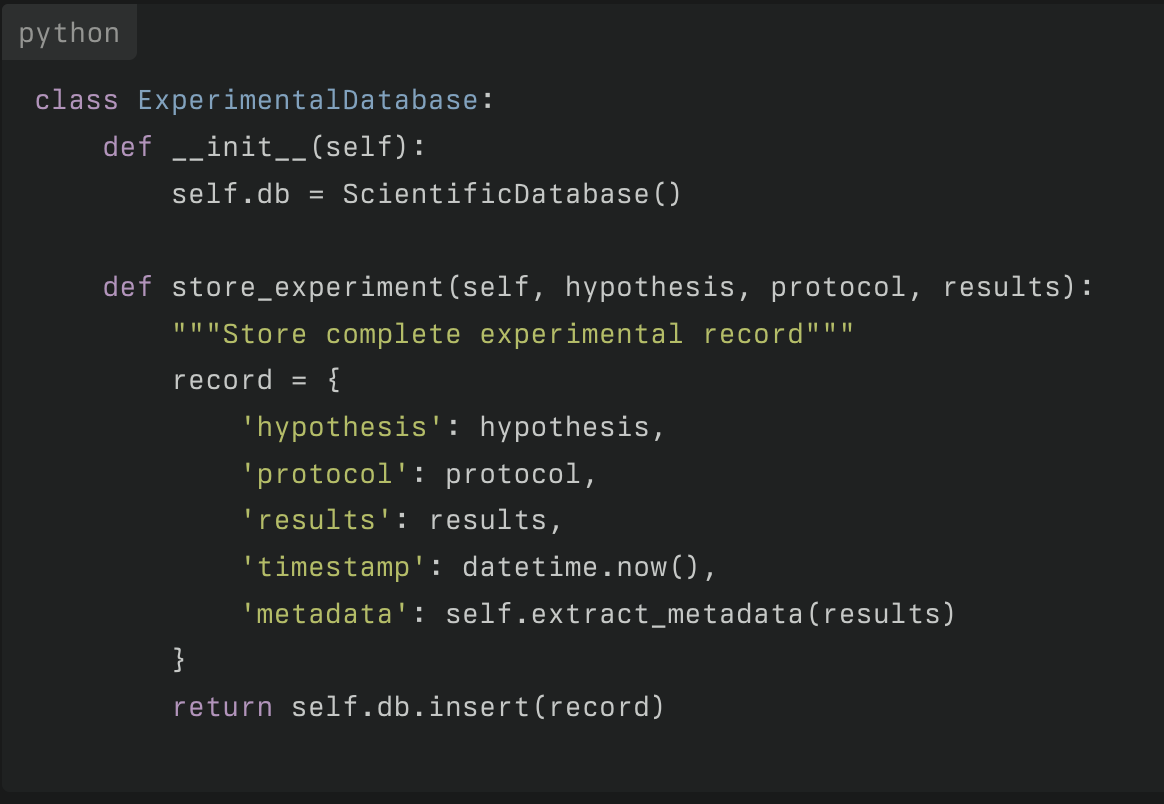
Scientific discovery requires persistent knowledge management across extended research campaigns. Agentic AI systems implement sophisticated memory architectures that maintain:
- Episodic memory: Records of past experiments and their outcomes
- Semantic memory: Structured knowledge about scientific principles and relationships
- Procedural memory: Learned protocols and experimental procedures
This memory system allows agents to build upon previous discoveries and avoid repeating unsuccessful approaches.
4. Collaboration Mechanisms
Modern scientific research is inherently collaborative, and agentic AI systems must coordinate with human researchers and other AI agents. This includes:
- Multi-agent coordination for parallel research efforts
- Human-AI teaming with appropriate delegation of responsibilities
- Cross-domain collaboration for interdisciplinary research challenges
5. Evolution and Adaptation
Perhaps most critically, scientific AI agents must continuously improve their performance based on research outcomes. This involves:
- Meta-learning to improve experimental design strategies
- Self-correction mechanisms for identifying and fixing errors
- Adaptive refinement of hypotheses based on new evidence
The Four-Stage Discovery Workflow
Agentic Science operates through a dynamic four-stage workflow that can reorder steps as results arrive, creating a flexible and responsive research process:
Stage 1: Observation and Hypothesis Generation
The discovery cycle begins with autonomous knowledge ingestion from multiple sources:
- Literature mining: AI agents systematically analyze vast scientific literature to identify knowledge gaps and research opportunities
- Data pattern recognition: Machine learning algorithms identify unexpected patterns in existing datasets that suggest novel hypotheses
- Cross-domain synthesis: Systems connect insights from disparate fields to generate innovative research directions
AI agents can now generate hundreds of research hypotheses in domains like cardiotoxicity research, with studies showing that 14% achieve high novelty scores and 65% demonstrate moderate innovation.
Stage 2: Experimental Planning and Design
Once hypotheses are formulated, agentic systems transition to experimental design optimization:
- Automated protocol generation: AI creates detailed experimental procedures optimized for specific research objectives
- Resource allocation: Systems balance experimental costs, time constraints, and expected information gain
- Dynamic tool integration: Agents select and configure appropriate instruments and methodologies
Self-driving laboratories exemplify this capability, with systems like AutoSciLab demonstrating autonomous experimental design across domains from projectile motion to complex nanophotonics challenges.
Stage 3: Data Analysis and Interpretation
The third stage involves comprehensive data processing and interpretation:
- Multimodal data extraction: Systems process diverse data types including images, spectra, numerical measurements, and textual observations
- Structured interpretation: AI agents convert raw experimental results into meaningful scientific insights
- Hypothesis filtering: Systems evaluate which hypotheses are supported or refuted by experimental evidence
Advanced systems can process 10 times more data than previous techniques while maintaining accuracy and extracting insights that might be missed by human analysis.
Stage 4: Synthesis and Validation
The final stage focuses on knowledge integration and quality assurance:
- Critical evaluation: AI agents assess the reliability and significance of their findings
- Self-correction mechanisms: Systems identify potential errors and iteratively refine their conclusions
- Adaptive refinement: The discovery cycle adapts based on results, potentially reformulating hypotheses or experimental approaches
This cyclical process ensures continuous improvement and robust scientific validation.
Real-World Applications Across Scientific Domains
Life Sciences: Accelerating Drug Discovery and Genomics
Agentic AI is making significant impacts in biomedical research through autonomous drug discovery platforms. These systems demonstrate remarkable capabilities:
Drug Discovery Applications:
- Molecular design: AI agents autonomously generate novel drug candidates by analyzing protein structures and predicting molecular interactions
- Clinical trial optimization: Systems streamline trial design, patient recruitment, and data analysis, reducing development timelines
- Personalized medicine: Agents integrate genomic, proteomic, and clinical data to develop individualized treatment strategies
Genomics Breakthroughs:
- Gene-disease discovery: AI systems identify novel genetic links for rare conditions through autonomous hypothesis generation
- Protein structure prediction: Building on AlphaFold's success, agentic systems now autonomously design therapeutic proteins and optimize their properties
Chemistry: Reaction Optimization and Synthesis
Chemical research has embraced self-driving laboratories for reaction discovery and optimization:
Automated Synthesis:
- Reaction pathway design: AI agents identify optimal synthetic routes for target molecules
- Catalyst development: Systems autonomously screen and optimize catalytic materials
- Process optimization: Agents fine-tune reaction conditions for maximum yield and selectivity
Materials Chemistry:
- Property prediction: AI predicts material properties from composition and structure
- Novel material design: Systems generate entirely new materials with desired characteristics
- Accelerated characterization: Automated analysis of material properties using integrated analytical tools
Materials Science: Property Prediction and Design
Materials science applications showcase the predictive power of agentic AI systems:
Discovery Acceleration:
- High-throughput screening: AI agents evaluate thousands of material candidates in parallel
- Structure-property relationships: Systems discover fundamental relationships between atomic structure and macroscopic properties
- Multi-objective optimization: Agents balance competing material properties like strength, weight, and cost
Practical Implementations:
Research at institutions like Brookhaven National Laboratory demonstrates AI agents identifying promising materials more quickly through automated X-ray diffraction analysis and intelligent experiment planning.
Physics: Theoretical Modeling and Experimentation
Physical sciences benefit from agentic AI through automated theoretical development and experimental design:
Theoretical Physics:
- Equation discovery: Systems like AutoSciLab autonomously rediscover fundamental physics principles like projectile motion and phase transitions
- Model development: AI agents propose and test new theoretical frameworks
- Parameter optimization: Systems fine-tune complex models with numerous parameters
Experimental Physics:
- Automated measurement: AI-controlled instruments perform systematic studies
- Data interpretation: Agents extract physical insights from complex experimental datasets
- Hypothesis testing: Systems design and execute tests of theoretical predictions
Self-Driving Laboratories: The Future of Automated Research
Defining Self-Driving Laboratories
Self-driving laboratories (SDLs) represent the physical manifestation of agentic science, combining artificial intelligence with robotic automation to create fully autonomous research platforms. These systems integrate:
- Automated experimental workflows: Robotic platforms perform synthesis, characterization, and testing
- AI-driven decision making: Machine learning algorithms plan experiments and interpret results
- Closed-loop optimization: Systems continuously refine experimental strategies based on outcomes
Current Implementations and Capabilities
Modern SDLs demonstrate remarkable capabilities across multiple domains:
Performance Metrics:
- Data generation: SDLs collect at least 10 times more data than traditional approaches at record speed
- Cost reduction: Automated systems slash research costs while reducing environmental impact
- Discovery acceleration: Research timelines compressed from years to months or weeks
Real-World Examples:
- Materials Discovery: NC State University's SDL achieved breakthrough speeds in materials characterization using continuous flow reactors
- Chemical Synthesis: The Matter Lab's platforms combine AI with robotics for autonomous materials optimization
- Drug Development: Pharmaceutical companies deploy SDLs for high-throughput screening and formulation optimization
Benefits and Current Limitations
Advantages of SDLs:
- 24/7 Operation: Continuous experimentation without human fatigue
- Reproducibility: Standardized protocols ensure consistent results
- Scale: Parallel processing of multiple research streams
- Safety: Reduced human exposure to hazardous materials and conditions
Current Challenges:
- Initial Investment: High upfront costs for equipment and integration
- Complexity: Sophisticated systems require specialized expertise
- Flexibility: Limited ability to handle unexpected situations
- Validation: Need for robust quality control and verification mechanisms
Implementation Guide: Building Agentic Science Systems
Required Technologies and Frameworks
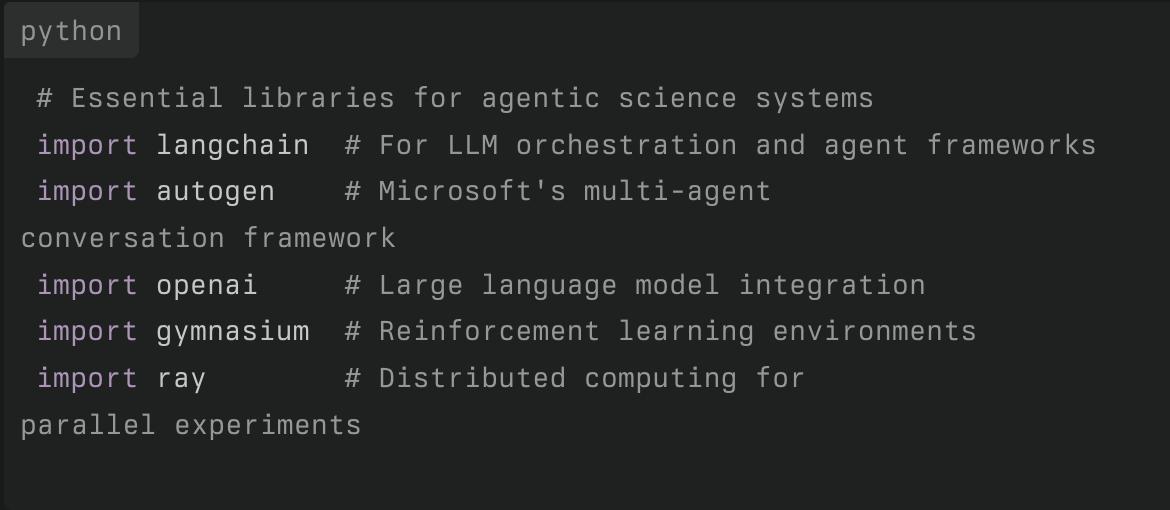
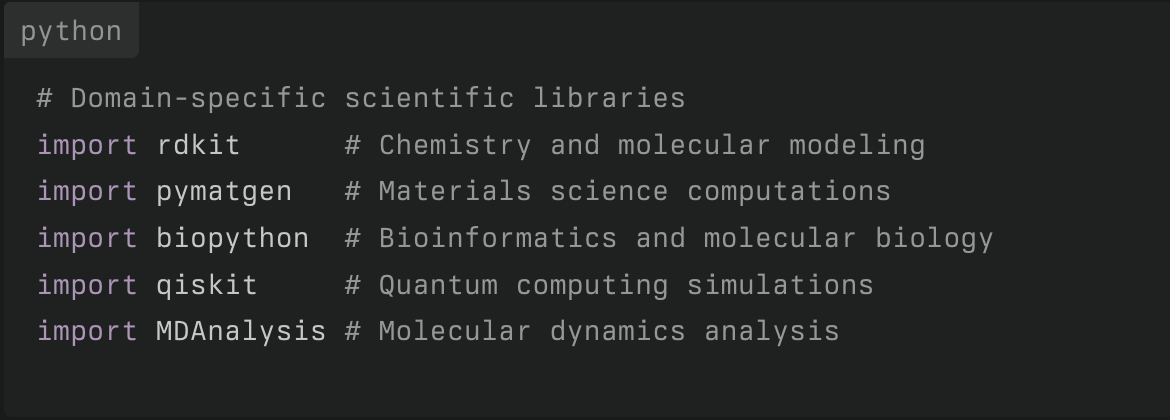
Building effective agentic science systems requires integration of multiple technology stacks:
Core AI Components:
Scientific Computing Stack:
Practical Implementation Example
Here's a simplified framework for building an agentic hypothesis generation system:
This file contains hidden or bidirectional Unicode text that may be interpreted or compiled differently than what appears below. To review, open the file in an editor that reveals hidden Unicode characters. Learn more about bidirectional Unicode charactersShow hidden characters
| class ScientificAgent: | |
| def __init__(self, domain, llm_model): | |
| self.domain = domain | |
| self.llm = llm_model | |
| self.memory = PersistentMemory() | |
| self.tools = ToolRegistry() | |
| def generate_hypotheses(self, research_goal): | |
| """Generate multiple research hypotheses""" | |
| context = self.memory.retrieve_relevant_knowledge(research_goal) | |
| literature = self.tools.literature_search(research_goal) | |
| prompt = f""" | |
| Research Goal: {research_goal} | |
| Context: {context} | |
| Recent Literature: {literature} | |
| Generate 5 novel, testable hypotheses addressing this research goal. | |
| For each hypothesis, provide: | |
| 1. Scientific rationale | |
| 2. Experimental approach | |
| 3. Expected outcomes | |
| 4. Potential limitations | |
| """ | |
| hypotheses = self.llm.generate(prompt) | |
| return self.rank_hypotheses(hypotheses) | |
| def design_experiment(self, hypothesis): | |
| """Create detailed experimental protocol""" | |
| tools_needed = self.identify_required_tools(hypothesis) | |
| protocol = self.generate_protocol(hypothesis, tools_needed) | |
| return self.optimize_protocol(protocol) | |
| def execute_workflow(self, research_goal): | |
| """Complete autonomous research workflow""" | |
| hypotheses = self.generate_hypotheses(research_goal) | |
| for hypothesis in hypotheses[:3]: # Test top 3 | |
| experiment = self.design_experiment(hypothesis) | |
| results = self.execute_experiment(experiment) | |
| analysis = self.analyze_results(results, hypothesis) | |
| self.memory.store_findings(hypothesis, experiment, results, analysis) | |
| return self.synthesize_conclusions() | |
| # Usage example | |
| agent = ScientificAgent(domain="materials_science", llm_model="gpt-4") | |
| results = agent.execute_workflow("Develop high-efficiency solar cell materials") |
view raw ScientificAgent.py hosted with ❤ by GitHub
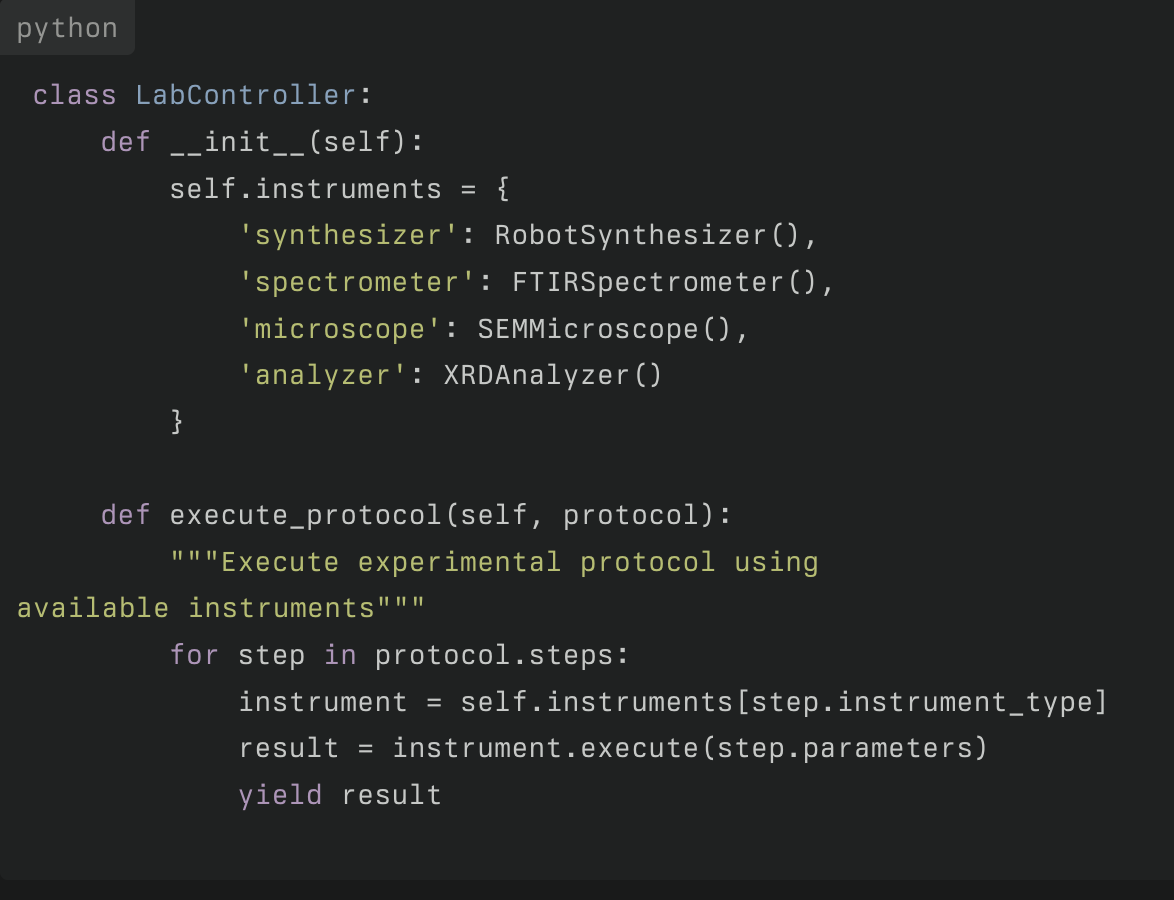
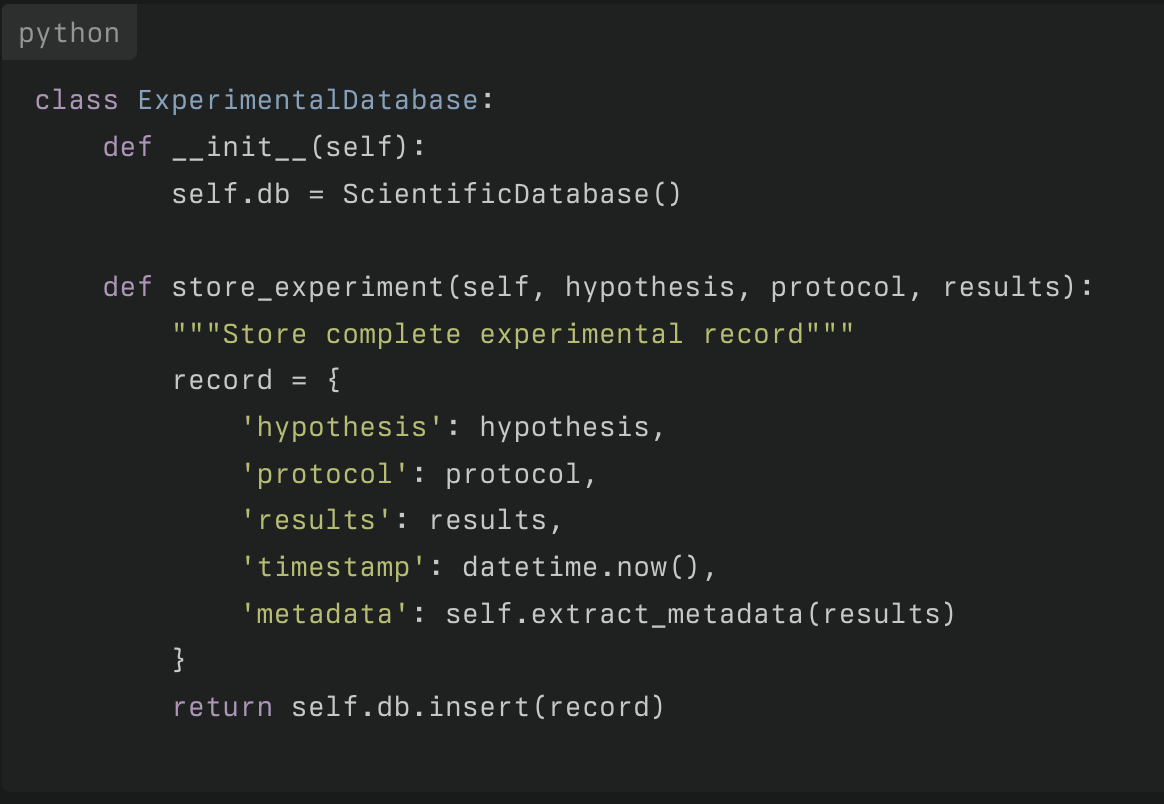
Integration with Laboratory Infrastructure
Hardware Integration:
Data Management:
Integration Best Practices
Quality Control:
- Implement multiple validation layers for hypothesis generation
- Use cross-validation techniques for experimental design
- Maintain audit trails for all autonomous decisions
- Include human oversight checkpoints for critical decisions
Scalability:
- Design systems with modular architectures for easy expansion
- Implement distributed computing for parallel hypothesis testing
- Use cloud infrastructure for computational scalability
- Plan for data growth with appropriate storage solutions
Challenges and Ethical Considerations
Validation and Reproducibility
The autonomous nature of agentic science systems introduces unique validation challenges:
Technical Challenges:
- Black box problem: Understanding how AI agents reach specific conclusions
- Reproducibility: Ensuring consistent results across different systems and conditions
- Error propagation: Preventing small errors from cascading through autonomous workflows
- Quality assessment: Developing metrics to evaluate autonomous research quality
Proposed Solutions:
- Explainable AI: Implementing interpretable models that can explain their reasoning
- Standardized protocols: Developing community standards for agentic science validation
- Benchmarking: Creating standardized test cases for evaluating system performance
- Multi-system validation: Requiring confirmation from independent agentic systems
Human-AI Collaboration Models
Successful agentic science requires thoughtful integration of human expertise with AI capabilities:
Collaboration Frameworks:
- Human-in-the-loop: Critical decisions require human approval
- AI-assisted: AI provides recommendations that humans evaluate and implement
- Supervised autonomy: AI operates independently within defined boundaries
- Full autonomy: AI systems operate with minimal human oversight
Role Evolution:
The skills required of future scientists will expand beyond domain expertise to include:
- AI orchestration: Managing teams of AI agents and automated systems
- Meta-science: Designing, validating, and governing autonomous research workflows
- Ethical oversight: Ensuring responsible use of autonomous research capabilities
Ethical Implications and Responsibilities
Research Integrity:
- Authorship questions: Who receives credit when AI systems make discoveries?
- Peer review: How do we evaluate research conducted primarily by AI agents?
- Publication standards: What disclosure is required for AI-generated research?
Societal Impact:
- Job displacement: Potential impact on research careers and employment
- Research equity: Ensuring agentic science benefits don't concentrate in well-resourced institutions
- Democratic participation: Maintaining human agency in setting research priorities
Safety Considerations:
- Unintended consequences: AI systems might pursue research directions with harmful implications
- Dual-use research: Managing AI systems that could generate dangerous knowledge
- Environmental impact: Ensuring automated research considers sustainability
Future Directions and Opportunities
Emerging Trends in 2025
The field of agentic science is rapidly evolving with several key trends emerging:
Advanced Reasoning Capabilities:
- Multi-step reasoning: Systems like Gemini 2.5 Pro demonstrate sophisticated problem-solving approaches that "actively think" through complex challenges
- Abstraction and Reasoning: AI agents increasingly handle abstract pattern recognition and transfer learning without explicit instructions
- Cross-domain synthesis: Enhanced ability to connect insights across different scientific disciplines
Multimodal Integration:
- Vision-language models: Systems that can simultaneously process text, images, and experimental data
- Sensor fusion: Integration of multiple measurement modalities for comprehensive analysis
- Real-time adaptation: AI agents that adjust experimental strategies based on visual and sensor feedback
Industry Applications and Market Opportunities
Pharmaceutical Industry:
- Accelerated drug development: Reducing development timelines from decades to years
- Personalized medicine: AI agents developing individualized treatment protocols
- Regulatory automation: Streamlining approval processes through automated documentation and compliance checking
Chemical Manufacturing:
- Process optimization: Real-time adjustment of industrial chemical processes
- Green chemistry: Automated discovery of environmentally sustainable synthetic routes
- Quality control: Continuous monitoring and adjustment of product quality
Materials and Energy:
- Battery development: Accelerated discovery of next-generation energy storage materials
- Solar cell optimization: Automated improvement of photovoltaic efficiency
- Sustainable materials: Discovery of biodegradable and recyclable alternatives
Research Infrastructure Evolution
Distributed Research Networks:
- Federated learning: Multiple institutions collaborating through shared AI agents while maintaining data privacy
- Cloud laboratories: Remote access to expensive research equipment through AI-mediated interfaces
- Global collaboration: AI agents facilitating international research partnerships
Educational Transformation:
- AI-assisted learning: Students working alongside AI agents to understand scientific principles
- Research training: New curricula focusing on human-AI collaboration skills
- Democratized access: Reducing barriers to advanced research through AI-powered tools
Long-term Vision: The Scientific Singularity
Looking ahead, agentic science may approach a "scientific singularity" where:
- AI agents autonomously discover fundamental scientific principles faster than humans can comprehend them
- Experimental cycles complete in minutes or hours rather than months or years
- Cross-disciplinary breakthroughs emerge from AI systems that can synthesize knowledge across all scientific domains
- Human scientists focus on setting research priorities, ethical oversight, and interpreting societal implications
This transformation could lead to unprecedented scientific acceleration, potentially solving major global challenges like climate change, disease, and resource scarcity within decades rather than centuries.
Conclusion: Embracing the Agentic Science Revolution
The emergence of agentic science represents a fundamental paradigm shift in how humanity approaches scientific discovery. As we've explored throughout this comprehensive analysis, AI systems are evolving from simple computational tools into autonomous research partners capable of hypothesis generation, experimental design, execution, and validation – the complete spectrum of scientific inquiry.
The five core capabilities of scientific AI agents – planning and reasoning, tool use, memory systems, collaboration mechanisms, and evolution – form the foundation for autonomous discovery workflows that can compress research timelines from years to weeks. Real-world implementations across life sciences, chemistry, materials science, and physics demonstrate the practical viability of these systems, with self-driving laboratories already achieving 10x performance improvements in data generation and discovery speed.
However, the transition to agentic science is not without challenges. Validation, reproducibility, and ethical considerations require careful attention as we integrate autonomous systems into scientific workflows. The evolution of human-AI collaboration models will determine how effectively we can harness these powerful capabilities while maintaining scientific integrity and societal benefit.
Looking toward the future, agentic science promises to democratize access to advanced research capabilities, accelerate solutions to global challenges, and potentially usher in a new era of scientific discovery that fundamentally transforms our understanding of the natural world. The key to success lies in thoughtful implementation that combines AI autonomy with human wisdom, ensuring that these powerful systems serve humanity's greatest challenges and aspirations.
For researchers, institutions, and organizations ready to embrace this transformation, the time to begin exploring agentic science implementations is now. The frameworks, tools, and methodologies outlined in this analysis provide a practical foundation for building autonomous research systems that can contribute meaningfully to scientific progress while maintaining the highest standards of quality, ethics, and human oversight.
The agentic science revolution is not a distant future possibility – it is happening today, reshaping laboratories and research institutions worldwide. Those who understand and adapt to this transformation will be positioned to lead the next generation of scientific discovery.
Keywords: agentic science, autonomous scientific discovery, AI for science, scientific AI agents, self-driving laboratories, automated research, hypothesis generation AI, scientific discovery 2025, machine learning research, AI research automation
References
- Original Research Paper: Wei, J., Yang, Y., Zhang, X., et al. (2025). From AI for Science to Agentic Science: A Survey on Autonomous Scientific Discovery. arXiv preprint arXiv:2508.14111.
https://arxiv.org/abs/2508.14111 - Hugging Face Papers – From AI for Science to Agentic Science: A Survey on Autonomous Scientific Discovery
https://huggingface.co/papers/2508.14111 - AI Spark – AI for Scientific Discovery- January 2025 Research
https://aispark.co.uk/ai-for-scientific-discovery-january-2025-research/ - Uplatz Blog – The Emergence of the Autonomous Scientist: How Agentic AI is Reshaping Scientific Discovery
https://uplatz.com/blog/the-emergence-of-the-autonomous-scientist-how-agentic-ai-is-reshaping-the-landscape-of-scientific-discovery/ - ML Science – The Technical Evolution of AI in 2025
https://www.ml-science.com/blog/2025/4/1/the-technical-evolution-of-ai-in-2025 - arXiv HTML – From AI for Science to Agentic Science: A Survey on Autonomous Scientific Discovery
https://arxiv.org/html/2508.14111v1 - NC State University – Researchers Hit 'Fast Forward' on Materials Discovery with Self-Driving Labs
https://news.ncsu.edu/2025/07/fast-forward-for-self-driving-labs/ - IBM – What is Multimodal AI?
https://www.ibm.com/think/topics/multimodal-ai - arXiv – A Self-Driving Laboratory For Interpretable Scientific Discovery
https://arxiv.org/abs/2412.12347 - Google Research – Accelerating scientific breakthroughs with an AI co-scientist
https://research.google/blog/accelerating-scientific-breakthroughs-with-an-ai-co-scientist/ - Encord – Top Multimodal AI Use Cases
https://encord.com/blog/multimodal-use-cases/ - The Matter Lab – AI for Discovery and Self-Driving Labs
https://www.matter.toronto.edu/basic-content-page/ai-for-discovery-and-self-driving-labs - JMIR – AI-Assisted Hypothesis Generation to Address Challenges in Clinical Research
https://www.jmir.org/2025/1/e66161 - ACS Chemical Reviews – Self-Driving Laboratories for Chemistry and Materials Science
https://pubs.acs.org/doi/10.1021/acs.chemrev.4c00055 - Bojdys Lab – Artificial Intelligence and Self-Driving Laboratories for Scientific Discovery
https://bojdyslab.org/artificial-intelligence-and-self-driving-laboratories-for-scientific-discovery-and-tech-transfer/ - CAS – AI models for chemistry: Charting the landscape in materials and life sciences
https://www.cas.org/resources/cas-insights/ai-models-for-chemistry-charting-the-landscape-in-materials-and-life-sciences - Brookhaven National Laboratory – AI Agent Helps Identify Material Properties Faster
https://www.bnl.gov/newsroom/news.php?a=218824 - YouTube – Agentic Science: Survey of Autonomous Discovery
- arXiv – Agentic AI for Scientific Discovery: A Survey of Progress, Challenges
https://arxiv.org/html/2503.08979v1 - LinkedIn – AI Agents in Life Sciences: Transforming Drug Discovery, Biotech
https://www.linkedin.com/pulse/ai-agents-life-sciences-transforming-drug-discovery-biotech-maleki-cryye
Thanks for reading Scaling Intelligence! Subscribe for free to receive new posts and support my work.
Ready to Build Your Own Agentic Science Solution?
Transform Your Research Ideas into Autonomous AI Systems with Sparrow Studio
As you've seen throughout this article, agentic science is revolutionizing how we approach scientific discovery. The question isn't whether AI will transform your research field—it's whether you'll be leading that transformation or watching from the sidelines.
Why Choose Sparrow Studio for Your Agentic AI Project?
🚀 Full-Stack AI/ML Expertise
We specialize in building end-to-end agentic AI systems, from hypothesis generation algorithms to self-driving laboratory integrations. Our team has deep expertise in:
- Large Language Models (LLMs) for scientific reasoning and hypothesis generation
- Multi-agent systems that can collaborate and iterate autonomously
- Scientific data processing and automated experimental design
- Cloud-native architecture that scales with your research needs
🔬 Scientific Domain Knowledge
Unlike generic software agencies, we understand the unique challenges of scientific workflows:
- Reproducibility and validation requirements
- Complex data pipelines and instrument integration
- Regulatory compliance in research environments
- Real-time analysis and decision-making systems
⚡ Proven Track Record
- 9+ years of enterprise software development experience
- 25,000+ hours of cumulative development across multiple domains
- Specialized experience with OpenAI, Hugging Face, and custom ML models
- Full-stack capabilities from frontend interfaces to backend AI orchestration
Our Agentic Science Services
Ready to Get Started?
Starter Package - $1,499/week
Perfect for proof-of-concept agentic AI tools and small research automation projects.
Growth Package - $5,399/month
Dedicated AI engineer to build and maintain your autonomous research systems.
Custom Enterprise - $25,000+ USD
Complete agentic science platform tailored to your specific research domain and requirements.
What Our Clients Say
Sparrow Studio transformed our materials discovery process. What used to take months now happens in days through their autonomous experimental design system.
Take Action Today
The agentic science revolution is happening now. Every day you wait is another day your competitors might gain an autonomous research advantage.
📅 Book a Free Consultation: cal.com/nazmul
📧 Email: [email protected]
🌐 Website: sparrow.so
🎯 Special Offer for Blog Readers:
Mention "AGENTIC-SCIENCE" when you contact us and receive a free 2-hour strategic consultation to discuss how agentic AI can accelerate your research goals.
Ready to build the future of scientific discovery? Let's turn your research vision into an autonomous reality.